 “Let’s see if we can come to consensus.”
Ahhh! Those can be scary words!
While well intended as a nice way to include everyone, consensus sometimes signals the beginning of a long, laborious – even nitpicking – process of group decision making.
It sometimes gives license to one member of the group to hold everyone hostage. And it can result in the watering down of a bold, new path forward into the lowest common denominator. Not inspiring.
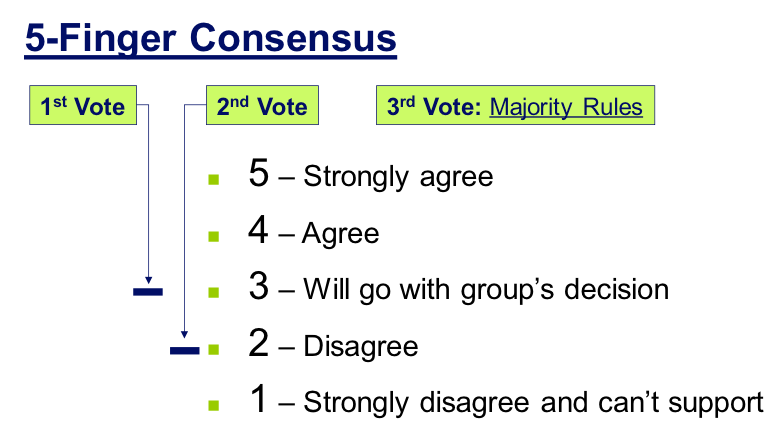
A different process that has many of the same advantages, but fewer drawbacks, is called Five Finger Consensus.
While it is unknown who exactly invented this process, I learned it through the great people at Leadership Strategies.
Here is how it works:
*Someone proposes an idea for the group’s consideration. After some discussion, a facilitator asks everyone at the count of three to hold up one – five fingers. The meaning of each finger:
- Five: Strongly Agree
- Four: Agree
- Three: I see pluses and minuses, but am willing to go along with the group
- Two: Disagree
- One: Strongly Disagree and can’t support
*If everyone votes 5, 4, or three – you are done and move on.
*If people have voted 2 or 1, they have an opportunity to share their concerns and suggest changes to the proposal. After they have shared, then the person who made the proposal is given the opportunity to make changes. If they make changes, then the voting starts all over at the beginning. If the originator of the proposal does not make a change, then a second vote is taken: same rules as before.
*If everyone votes 5, 4, 3, or 2 the second time – then the proposal is approved. The people voting “2” have signaled that they are not going to block this. If someone votes “1,” then they – once again have an opportunity to share why and make recommendations for improvement. After they have shared, then the person who made the proposal is given the opportunity to make changes. If they make changes, then the voting starts all over at the beginning. If the originator of the proposal does not make a change, then you take a simple vote with hands raised, for and against – majority rules.
Five Finger Consensus may not be needed for every group decision, and it will not work for every organization culture, but it is a good option to consider. It ensures that everyone is heard and that no small group can derail the effort.